
Author, educator, and psychologist Dr. Melvin P. Sikes was a member of the Tuskegee Airmen, the renowned unit of fighter pilots who flew during World War II. After the war, he embarked on a career in academic psychology that eventually led him to the University of Texas at Austin, where he was a professor of education psychology and a one-time member of the Hogg Foundation’s National Advisory Council. We are taking a look back at this remarkable man and his impact.
Today on Into the Fold, we’re drawing from the Hogg Foundation archives to share a recorded broadcast of The Human Condition. Airing from 1971 to 1983 and hosted by former Hogg program officer Bert Kruger Smith, this unique radio show featured conversations spanning the full range of human interest involving mental health.
Smith interviews Dr. Sikes about the creation of the Center for Improvement of Intergroup Relations at UT, as well as other matters close to his heart as a member of the University community during a period of rapid social change. Luester Batieste and Sandy Chatham, students of Dr. Sikes and staff members at the Center, contribute to the conversation as well.
Providing additional context and commentary on Dr. Sikes’ work from a contemporary perspective are Ike Evans, Hogg Foundation communications manager, and Elizabeth Stauber, the foundation’s archivist and records manager.
Center for Improvement of Intergroup Relations
In addition to his professorial role within academia, Dr. Melvin Sikes took on a significant community-facing role as the founder of the Center for Improvement of Intergroup Relations (Center). As an important field of sociological study in the 1970s, intergroup relations sought to better understand the perceptions, thoughts, and interactions between people of differing social groups, particularly as it related to the civil rights movement.
Dr. Sikes envisioned the Center playing an important role in connecting the academic community at UT with the larger Austin community.
“People often feel that the university is not concerned with the ‘man out there in the field’,” said Dr. Sikes. “We are. And we want to show that concern in the way that we can best do it.”
Continuity with the Hogg Foundation
Under the direction of Dr. Wayne H. Holtzman, the Hogg Foundation supported the development of the Center and its four areas of focus: research, sharing expertise, community engagement, and the creation of an informational database. Indeed, a continuity of shared priorities can be seen between the two organizations.
For example, to ensure it truly met the needs of the community it served, the Center researched and measured the impact of its programming. Similarly, the Hogg Foundation strives to continually learn and improve as an organization by evaluating our impact at the community level and providing financial support for UT students conducting research in the behavioral health field.
The Center also enabled smaller community organizations to “do their own thing” by providing access to resources and information rather than issuing directives, an approach that closely resembles the Hogg’s focus on community-led initiatives.
Student Involvement
Students of Dr. Sikes, such as Sandy Chatham and Luester Batiste, also went beyond the classroom to support the Center as volunteers and staff members.
Reflecting on her experiences as a student in Dr. Sikes’ Cultural Deprivation course, Sandy described the evolution of her attitudes and behaviors toward people with differences and how it motivated her to join the Center’s staff.
“There’s such a tremendous demand to work out intergroup problems,” she said. “There’s always more to be done.”
Luester expressed similar feelings about her experiences in Sikes’ classroom and at the Center.
Well-being for All Texans
Another example is the Crystal City project, an innovative effort to build a mental health outreach program for the predominantly rural, Spanish-speaking, and economically underserved area of Zavala County, in South Texas.
“How far back and deep the concern the Hogg Foundation has had for the mental health of all Texans is always inspiring to see,” says Elizabeth.
Related Content

Learning Forward: What the Future Demands from Researchers and Institutions
What have institutions and researchers learned and what should we do with those lessons? Our guests have spent their careers asking those very questions.

Designing Belonging: Third Spaces as Mental Health Infrastructure
The Austin Public Library system provides some of the most visible and accessible third space systems in the city. It is a network of spaces that serve people across ages, backgrounds, and life experiences.
Educators As Architects of Change
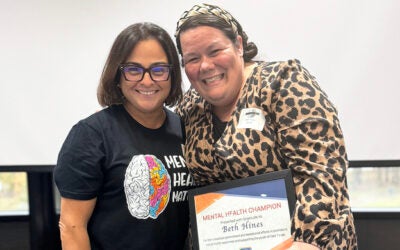
Beth Hines takes a whole system approach to student mental health through a program at Arp Elementary School.