What Communities Learned About Building Collaboratives
Lessons from developing and running community collaboratives

The evaluation conducted by our partners at the Texas A&M School of Public Health identified several lessons learned about what helps community collaboratives take root and thrive in rural communities. Drawing on participant reflections from multiple counties involved in the Collaborative Approaches to Well-Being in Rural Communities initiative, the findings highlight the importance of building strong relationships, establishing clear structures, and remaining adaptable to local contexts and changing circumstances.
This evaluation is based on collaborative participant reflections across multiple counties.
This infographic summarizes key lessons learned from communities that participated in the initiative. Across all stages of the work, from forming collaborative groups to sustaining momentum over time, participants emphasized that successful community change depends as much on trust, shared leadership, and local engagement as it does on formal planning or evidence-based strategies. They found that community collaboratives are most effective when they are grounded in community values, supported by trusted local organizations, and paced to match local capacity.
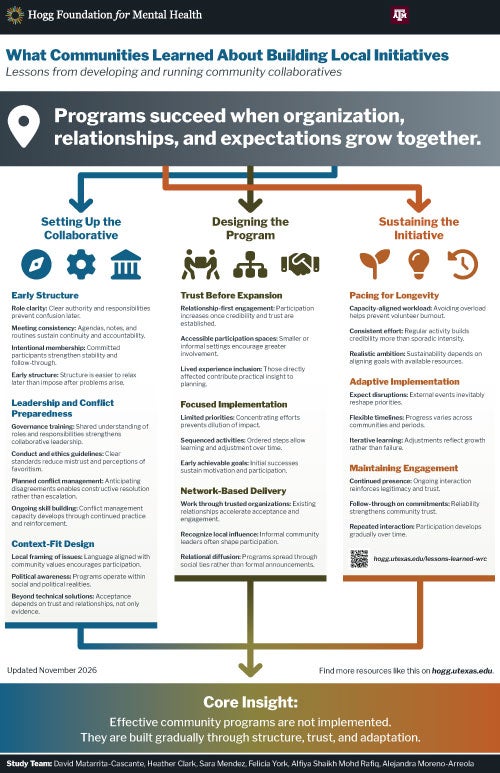

Setting Up the Collaborative

Early Structure
Role clarity: Clear authority and responsibilities prevent confusion later.
Meeting consistency: Agendas, notes, and routines sustain continuity and accountability.
Intentional membership: Committed participants strengthen stability and follow-through.
Early structure: Structure is easier to relax later than impose after problems arise.
Leadership and Conflict Preparedness
Governance training: Shared understanding of roles and responsibilities strengthens collaborative leadership.
Conduct and ethics guidelines: Clear standards reduce mistrust and perceptions of favoritism.
Planned conflict management: Anticipating disagreements enables constructive resolution rather than escalation.
Ongoing skill building: Conflict management capacity develops through continued practice and reinforcement.
Context-Fit Design
Local framing of issues: Language aligned with community values encourages participation.
Political awareness: Programs operate within social and political realities.
Beyond technical solutions: Acceptance depends on trust and relationships, not only evidence.
Designing the
Program

Trust Before Expansion
Relationship-first engagement: Participation increases once credibility and trust are established.
Accessible participation spaces: Smaller or informal settings encourage greater involvement.
Lived experience inclusion: Those directly affected contribute practical insight to planning.
Focused Implementation
Limited priorities: Concentrating efforts prevents dilution of impact.
Sequenced activities: Ordered steps allow learning and adjustment over time.
Early achievable goals: Initial successes sustain motivation and participation.
Network-Based Delivery
Work through trusted organizations: Existing relationships accelerate acceptance and engagement.
Recognize local influence: Informal community leaders often shape participation.
Relational diffusion: Programs spread through social ties rather than formal announcements.
Sustaining the
Initiative

Pacing for Longevity
Capacity-aligned workload: Avoiding overload helps prevent volunteer burnout.
Consistent effort: Regular activity builds credibility more than sporadic intensity.
Realistic ambition: Sustainability depends on aligning goals with available resources.
Adaptive Implementation
Expect disruptions: External events inevitably reshape priorities.
Flexible timelines: Progress varies across communities and periods.
Iterative learning: Adjustments reflect growth rather than failure.
Maintaining Engagement
Continued presence: Ongoing interaction reinforces legitimacy and trust.
Follow-through on commitments: Reliability strengthens community trust.
Repeated interaction: Participation develops gradually over time.

Effective community programs are not implemented.
They are built gradually through structure, trust, and adaptation.
These findings reinforce a central theme of the initiative: meaningful and lasting community well-being is built gradually through partnership, learning, and adaptation. We invite you to explore and download the infographic to learn more about the practical lessons communities shared for strengthening collaborative, community-driven approaches to well-being.
Study Team: David Matarrita-Cascante, Heather Clark, Sara Mendez, Felicia York, Alfiya Shaikh Mohd Rafiq, Alejandra Moreno-Arreola
Related Content
Infographic: What Communities Learned About Building Collaboratives
Lessons learned about what helps community collaboratives take root and thrive in rural communities.

Partnership Across Distance: The Texas Panhandle
In today’s episode, we look at how partnerships can stretch across counties and communities to align resources and ensure that rural Texans don’t have to navigate care alone.

The Hogg Foundation and Partners Have Awarded $6.5 Million in Grants to Support Well-being in Rural and Rural Border Communities
Hogg Foundation and Partners Have Awarded $6.5 Million in Grants to Support Well-being in Rural and Rural Border Communities