
Rio Grande Valley Policy Initiative
Request for proposals from eligible organizations in South Texas to support organizations engaged in local policy work and to build local organizational capacity to enable sustained, strategic engagement in policy processes that advance mental wellness and address non-medical drivers of health.This funding opportunity is now closed. Check out our open opportunities or TGRC’s statewide opportunities list.
The Hogg Foundation for Mental Health invites eligible organizations in South Texas, especially those in the Rio Grande Valley (Cameron, Hidalgo, Starr, or Willacy Counties), to submit a proposal to support organizations engaged in local policy work, and to build local organizational capacity to enable sustained, strategic engagement in policy processes that advance mental wellness and address non-medical drivers of health. Each grantee partner will receive a three-year grant, with an award amount of up to $70,000 per year divided equally across the grant term. Each selected organization will have access to additional capacity building support through the University of Texas Rio Grande Valley’s Nonprofit Resource Center.
Grant Proposal Details
Who Can Apply:
- Nonprofit 501(c)(3) organizations, governmental entities, and higher education institutions in South Texas
- Applicants who operate, or have offices, chapters, or affiliates, in Brooks, Cameron, Duval, Hidalgo, Jim Hogg, Jim Wells, Kleberg, Nueces, San Patricio, Starr, Webb, Willacy, or Zapata counties. We have a strong preference for applicants in the Rio Grande Valley (Cameron, Hidalgo, Starr, or Willacy Counties)
- NOTE: Applicants without a 501(c)(3) status may apply under a fiscal sponsor if they meet all other eligibility criteria. To learn more about applying under a fiscal sponsor, visit Grant Application Frequently Asked Questions.
- NOTE: Proposals submitted as a collaborative project between multiple organizations are welcome, but the lead applicant (fiscal sponsor) must be based in South Texas, and the role of each organization must be clearly identified in the proposal.
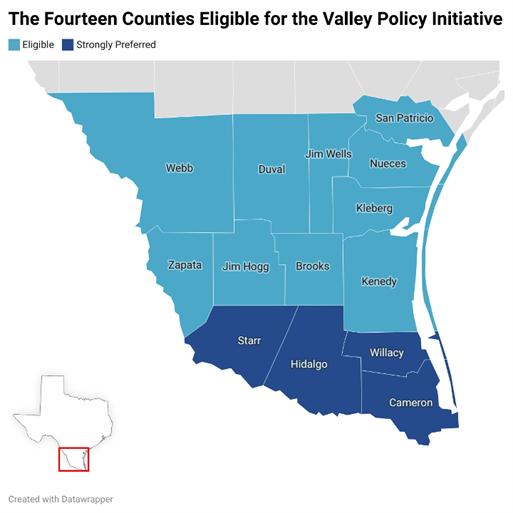
- Organizations who do any of the following:
- Engage at any stage of issue education or policy engagement, including organizations that understand how public systems impact their clients or communities
- Provide opportunities for community members to learn about public issues, such as hosting informational sessions, distributing educational materials, offering digital or in‑person outreach, or raising awareness of how policies relate to mental health and well‑being
- Help community members understand and navigate public processes, including introducing residents to school board or county commissioner meetings, supporting the preparation of public testimony, or offering civic learning workshops
- Cultivate community leadership or collaboration around shared issues, including convening listening sessions, forming advisory groups, building partnerships, or engaging residents with lived experience in shaping local conversations about community priorities
We Cannot Fund:
- Organizations whose mission statement or programs are solely focused on race/ethnicity, sexual orientation, or gender identity (as a part of The University of Texas System, the Hogg Foundation’s funding follows the University of Texas at Austin’s internal governance framework and complies with Texas Senate Bill 17)
- Projects or proposals that are solely clinical, recreational, or programmatic in nature and do not incorporate any components related to public issues, policy topics, or civic engagement
- NOTE: Organizations that offer clinical/direct programs and services may still apply if their proposal relates to local policy engagement. Awarded funds cannot be used to support clinical/direct programs or services.
- Capital campaigns
- Private foundation endowments
- Individuals
About the Initiative
As Texas communities navigate an increasingly complex and uncertain landscape, strengthening policy engagement and advocacy capacity is essential. By investing in organizations that advocate for their communities, the Rio Grande Valley Policy Initiative (VPI) seeks to amplify the voices of Rio Grande Valley (RGV) residents and ensure that policies reflect the lived experiences of those most affected.
The Hogg Foundation for Mental Health invites eligible organizations in South Texas, especially those in the Rio Grande Valley (Cameron, Hidalgo, Starr, or Willacy Counties), to submit a proposal to support organizations engaged in local policy work, and to build local organizational capacity to enable sustained, strategic engagement in policy processes that advance mental wellness and address non-medical drivers of health. Each selected organization will have access to additional capacity building support through the University of Texas Rio Grande Valley’s Nonprofit Resource Center.
Initiative Goals
The VPI aims to achieve the following:
- To support forward-looking strategies that empower local leaders
- To expand participation in policymaking
- To advance sustainable, community-driven solutions for the RGV and surrounding South Texas counties
Key Dates
| Event | Date and Time |
| Webinar Questions Due Send questions for the webinar up to 24 hours in advance. |
Wednesday, May 13, 2026 10:30 am, Central Standard Time (CST) |
| Webinar Registration Deadline Optional training from Texas Grants Resource Center. |
Thursday, May 14, 2026 10:30 am, CST |
| Informational Webinar (Optional) Instructions will be provided to registrants upon registration. | Thursday, May 14, 2026 10:30 – 11:30 am, CST |
| Webinar Q & A To be posted on this webpage |
Monday, May 18, 2026 3:59 pm, CST |
| Registration Deadline Applicants must create an account before they can apply. | Friday, May 29, 2026 3:59 pm, CST |
| Proposals Due | Friday, June 5, 2026 11:59 pm, CST |
| Awardees Notified | August 2026 |
| Grant Term | October 2026 – September 2029 |
How Applications Are Reviewed
Proposals (including proposed budget) will be reviewed and scored based on the following criteria:
| Rating Categories | Possible Points |
|---|---|
| Mental Health and Well-being: The proposal shows that the organization’s work aligns with the Hogg Foundation’s mission to support Texas communities’ capacity to advance mental health in everyday life by addressing upstream issues that impact mental health and well-being. This includes showing how proposed policy efforts address key non-medical drivers of mental health. | 5 |
| Policy Need: The proposal clearly identifies the policy issues impacting its community’s mental health and the organization’s areas for growth in local policy engagement. This includes explaining how the grant will strengthen its capacity to participate effectively in policy processes. | 5 |
| Impact: The proposal demonstrates strong potential to generate meaningful and sustainable impact through local policy engagement. This includes contributions to long-term systems improvement, stronger civic participation, shifts in local narratives or decision-making, strengthened community power, or concrete policy outcomes. | 15 |
| Capacity Need: The proposal shows that the organization clearly identifies its areas for growth and describes how this grant will enhance its ability to fulfill its mission and serve its community. | 15 |
| Impact: The proposal predicts measurable outcomes that will improve community mental health and well-being. | 15 |
| Budget: The proposed budget shows that expenses are justified. | 5 |
| Total | 60 |
Grant Term
The grant will last 3 years (36 months) and is expected to begin in October 2026.
Reporting Requirements
Reporting requirements and due dates for awardees will be clearly stated in a Statement of Agreement between the grantee partner and the foundation. The grantee partner will provide annual year-end reports describing how the grant was implemented during the previous year.
Submit a Grant Proposal
You must submit your complete proposal through the Hogg Foundation’s grant management system, Fluxx. You will need to enter a federal tax ID number to get started. Important: The system will log you out after 30 minutes and not save your work. We recommend writing your answers in a separate document and copying and pasting them into Fluxx.
Training and Support

Texas Grants Resource Center will offer a free, optional webinar on proposal writing and budgeting. See Key Dates for details.
Send webinar questions, no later than 24 hours in advance, to the Grants Management team.
The proposal must include:
- Summary/Highlights of Your Proposal Narrative. Provide a brief summary of the Proposal Narrative (described below) and any additional information that you would like us to know (1500-character limit).
- Proposal Narrative. Provide answers to the questions below. Although there is no character limit, we recommend 3500-11,000 characters in total.
- What is your organization’s origin story, and how do your current local advocacy efforts support the mental health and well-being of your community?
- What policy issues are impacting mental health and well-being in your community and how is your organization best suited to address these issues?
- How are your organization’s priorities informed by your community? Please provide examples.
- How would your advocacy improve mental health and well-being in your community?
- How would this opportunity improve your organization’s ability to engage in public advocacy?
- Budget. Include a budget with your proposal. You will find the budget template in Excel format in the Application Documents section of Fluxx, under Required Application Documents.
Complete, save, and upload the budget template in the Application Documents section of Fluxx. Instructions for completing this document can be found in the first tab of the budget template.
- Fiscal Documents. Provide fiscal documents with your proposal. They will be provided by your organization’s fiscal office.
Upload the following documents to the Fiscal Documents section in Fluxx to help the Hogg Foundation assess your organization’s financial stability.
-
- IRS letter of determination of 501(c)(3) status or tax-exempt status
- Most recent IRS Form 990 or Form 990-N (e-Postcard)
- Current operating budget
- Statement of activities (income statements) from the past year
- Statement of financial position (balance sheets) from the past year
Background and Definitions
Background
This background document is available for those who would like to learn more about the needs addressed by this initiative.
Definitions
Local Government: Decision makers that are elected to school boards, city councils, mayoral offices, sheriff’s offices, district attorney’s offices, justices of the peace courts, and/or county commissioners’ courts. Local government does not include state or national lawmakers, state or national offices or agencies, or high appellate courts such as the Supreme Court.
Issue Education: Helping community members identify and understand the issues that affect their well‑being, such as access to healthcare, housing, or local services
Non-Medical Drivers of Health: The everyday, non-medical conditions that influence a person’s health, such as housing, education, and income
Upstream Issues: The root causes of challenges to mental health and well-being, such as social, economic, and environmental conditions
Community: A geographic area where people can work together to build resilience and improve mental health, including the places where people live, learn, work, pray, and play
Fiscal Sponsor: A 501(c)(3) organization that manages a grant’s financial and administrative responsibilities on behalf of a community collaborative or another organization
Fluxx Grants Management System: An online platform that manages grant applications and processes
Mental Health and Well-being: Mental health, as defined by the World Health Organization, is “a state of well-being in which the individual realizes his or her abilities, can cope with the normal stresses of life, can work productively and fruitfully, and can make a contribution to his or her community.”
Origin Story: An explanation of how and why an organization was founded. An origin story typically includes the circumstances, motivations, values, and key events that led to an organization’s creation, as well as its mission or the problem it aims to address.
Frequently Asked Questions
We are not a policy-focused organization, are we still eligible to apply?
Yes. Your organization does not need to focus primarily on policy to be eligible to apply. It only needs to demonstrate some level of previous policy engagement or issue education.
What do you mean by policy engagement?
Policy engagement refers to any activities that help community members understand and engage with public issues, public systems, or how decisions are made by their local government.
We don’t have staff dedicated to policy work, are we still eligible to apply?
Yes. Many eligible organizations do not have specialized policy staff. Eligibility focuses on whether your organization incorporates any activities that help people understand public issues or public processes to make changes to local policy.
Does sharing information digitally (email, website, or social media) count as issue education?
Yes. Sharing policy updates, community alerts, public meeting information, or educational content online all qualify as issue education and would make an organization eligible for this grant opportunity.
Does the grant have to fund a new project, or can it support our current work?
Either is acceptable. Applicants may request funding to strengthen existing work or to develop new projects that align with the Valley Policy Initiative.
Am I required to attend the webinar? If I can’t attend, where can I access a recording of the webinar?
No. Attending the webinar is optional. The webinar will be recorded, and a link to the recording will be added to this webpage. Any questions asked during the webinar that are not already addressed in this FAQ section will be added to this webpage.
Can I submit questions before the webinar? How will unanswered questions from the webinar be addressed?
Yes. You can submit questions before the webinar by sending them to hogg-grants@austin.utexas.edu. See the Key Dates table to find the deadline for submitting questions.
You can also ask questions during the webinar. Any questions from the webinar that are not already addressed in this FAQ section will be added to this webpage.
If our organization received a past Hogg Foundation grant, are we eligible to receive a VPI grant?
Yes. Even if your organization has received a Hogg Foundation grant in the past, as long as you meet all of the VPI initiative’s eligibility requirements you may apply.
My organization provides traditional and nontraditional clinical services. Can I still apply?
Yes. Organizations who provide traditional and nontraditional clinical services are eligible to receive a grant. However, they may not fund those specific services with the grant award. Funding from the VPI initiative may only be used for an organization’s capacity building efforts.
For the purposes of this initiative, clinical services include, but are not limited to, compensation for clinical staff or the direct provision of clinical services to individuals or groups.
Can my organization partner with a fiscal sponsor?
Yes. If your organization does not currently have 501(c)(3) status, you may partner with an organization that does currently have 501(c)(3) status. This partner organization will serve as your fiscal sponsor. It will manage the fiscal responsibilities and fiscal requirements of the grant.
If you intend to apply by partnering with an organization that will serve as your fiscal sponsor, please add the organization’s name, address, city, state, and postal code to your application. Please also include the name, email, and phone number of a contact person from the sponsoring organization. If there is an existing Memorandum of Understanding (MOU) between your organizations, please upload the document to Fluxx.
Is there a required budget template?
Yes. There is a required budget template provided in Fluxx that you must complete and upload as part of your application. You can view and download the budget template before registering.
Webinar Video
Did you miss the Rio Grande Valley Policy Initiative webinar? Want to watch again? Send additional questions to the Grants Management team.
Related Content
The Hogg Foundation Awards $2.275M to Support Advocacy for Mental Health and Well-being in the Rio Grande Valley and Surrounding South Texas Counties
The Hogg Foundation awards $2.275M to support advocacy for mental health and well-being in the Rio Grande Valley and surrounding South Texas communities.
What Comes After the Crisis: Avoiding Whiplash in Reform Efforts
Our latest podcast explores what it takes to avoid “reform whiplash”, the cycle in which systems lurch forward during crisis only to stall or regress once public attention shifts.

Policy: Telling Your Story
Explore how you can use your personal story to shape systems, influence policy, and make their communities stronger.