
 This piece was written by Karen Wesley Weaver, a member of the Contributors Circle at the Hogg Foundation for Mental Health. The views expressed in this post do not represent those of the Hogg Foundation.
This year, World Mental Health Day’s theme is “It’s Time to Prioritize Mental Health at Work.”
I interviewed Ashleigh Vaughn, a friend, fellow writer, mother, and creative technologist, to bring a human story to this year’s theme.
I connected with Ashleigh through our Substack publications. My publication, “I Write Hard Things,” chronicles my lived experience with mental health, late ADHD diagnosis, and my healing journey as a mother of two autistic young adult sons and a wife of 30 years.
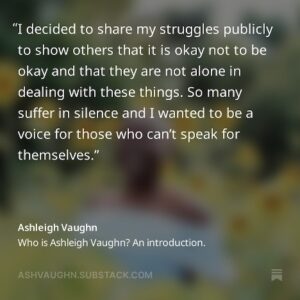
Ashleigh’s publication, Here Comes The Sun, is a space where she openly shares her lived experiences with bipolar disorder. Her insightful writing helps her readers better understand mental illness’s challenges.
Workplace Mental Health: Ashleigh’s Story
Thank you for your willingness to share your story. What can you tell me about the work you do?
I am a Senior IT Specialist for my county government. Most of my career has been spent in various technology consulting roles. My professional specialties are Human-Centered Design, Business Analysis, and Business Process Improvements.
Do you work at home or in an office?
I am hybrid. Two days in the office, three at home.
What impact does the ability to work at home have on your mental health?
Being able to work from home is everything. Especially on those days when my mental health may not be the greatest. I don’t have to put effort into looking presentable, make small talk with people, and be in an overstimulating environment all day. I can rest in my downtime during the day and have the flexibility to make up time after hours if need be.
What has been your experience with child care and flexibility with your employer?
I’m blessed to have an extremely flexible employer. I leave early on my office days to go pick Ava up. I have to drive in the opposite direction of home and traffic is a beast. Being able to leave early to try and beat some of it is helpful.
 Have employers you worked for created a culture of mental health and well-being in the workplace? If so, how?
My last employer did an excellent job at doing so, but only after years of having a culture that contributed to decreased mental health. Even though they were a consulting firm, they created a division for mental health and hired actual mental health professionals to create programs and offerings to employees outside of EAP. We also had affinity groups and I was the lead at one point of the Well-being team. We were tasked with putting on wellness activities and events for our fellow project members and were given a generous budget to do so.
Have you had experiences in the workplace with stigma, discrimination, or harassment because of your mental health or that impacted your mental health?
I am fortunate enough to have not experienced any of those things directly due to my mental health. I have the privilege of being able to mask which I did for most of my life, and most people would not know that I was mentally ill had I not disclosed it. I am open and honest about having bipolar disorder not only with my direct leadership but with my peers as well and for the most part my colleagues have been understanding and supportive.
What initiatives would you like to see employers develop to create a culture of mental health at work?
I wish more companies started with better mental health care coverage in available healthcare plans and a more expansive EAP if it exists. Meeting access needs help fight half the battle because it opens up options for treatment, support, and care. What would also be nice to have is if more companies put effort into making the culture of the workplace a safe place to unmask. It starts with leadership setting the example in order to have a trickle-down effect.
Doing so will definitely have a positive impact for both employers and employees. Healthy employees are ultimately more effective and productive, which ultimately benefits all parties.
World Health Organization
According to the World Health Organization, “workplaces that promote mental health and support people with mental disorders are more likely to reduce absenteeism, increase productivity and benefit from associated economic gains.”
In my research I found that employers offer programming like sleep improvement workshops, pet therapy, and employee activities to create a sense of community, including group fitness activities, having meditation and yoga instructors come in and speakers on topics like mindfulness and burnout.
The World Health Organization hopes that by creating awareness more employers will be motivated to create a culture of mental health in the workplace to support their employees’ health and well-being.
Better mental health culture in workplaces will have a positive impact for both employers and employees. Healthy employees are ultimately more effective and productive.
Related Links
Introducing Hogg News
If you do a search for "Hogg Foundation newsletter" at The University of Texas Digital Repository, you will find examples dating back to 1955. Since at least that time, the Hogg Foundation has recognized the importance of timely and regular communication with the...
Local Clergy Get Trained in Mental Health First Aid
“Maybe your faith isn’t strong enough.” “You should just pray a little harder.” “Girl, the devil is just trying to steal your joy!” Sound familiar? Chances are you’ve said something similar to someone you know who is “going through” a mental health challenge, or...
On the Tragedy at Fort Hood
As a nation we'll spend the next weeks and months trying to piece together the details of the shootings this week at Fort Hood. One thing we know right now, which is the most important thing, is that four people are dead (one of them the shooter), 16 are...
Q&A with Yije Wang
Yije Wang, a doctoral student in the Human Development and Family Services Graduate Program at The University of Texas at Austin, was selected to receive the 2014 Frances Fowler Wallace Memorial for Mental Health Dissertation Award by the Hogg Foundation. The award...
No April Fools Here: Finding Common Ground and Building Community
This post was cross-posted from the Texas Network of Youth Services blog. by Lara O'Toole, The Harris County Transition-Age Youth and Families Initiative is an opportunity for youth, young adults, parents/caregivers, and service providers to come together to...
Peer Support, Peer Problems
As a grantmaking foundation, the Hogg Foundation is privy to a world of rich conversations about mental health, a world that we are often unable to do justice to in the course of everyday business. Sometimes, however, an opportunity presents itself for us to mine our...