
In schools across Texas, educators are being asked to do something extraordinary support learning while also responding to rising levels of anxiety, trauma and emotional distress among students. But what if schools weren’t just responding to these challenges? What if they were designing new systems to meet them?
This episode explores how educators can become architects of change, building environments where social emotional well-being is part of the foundation of learning. Our guest is Beth Hines, principal of Arp Elementary School which takes a whole system approach to student mental health through the Arp Creating Pathways to Social Emotional Well-Being for All Students program. In 2023, Arp Independent School District was a recipient of a Reliable Flexible Funding grant from the Hogg Foundation.
Student Emotional and Behavioral Challenges
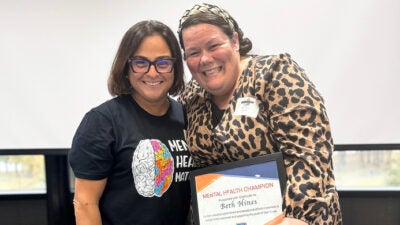 “More than ever before, especially post-pandemic, teachers are seeing an increase in students’ inability to regulate their emotions,” says Beth. “They have very limited executive functioning skills like conflict resolution when they’re coming to school, as well as an increase in physically aggressive behaviors.”
Teachers are struggling to keep up with the ever-changing needs of these students. While teach certification equips them to be successful teachers of academic skills, without additional training, they often don’t have the tools needed to teach students social emotional regulation skills.
“The RFF grant from the Hogg Foundation has given us the opportunity to provide that training to our teachers — trauma training, social emotional skills training, and so on,” says Beth. ” Because if students aren’t emotionally regulated, they can’t learn to read; they can’t learn to add. So now we’re kind of backtracking and giving them what their body and emotions need in order to learn.”
A Multi-tiered System of Support
Support for social emotional well-being support at Arp Elementary School uses a multi-tiered response system, similar to the system used for academic support.
“When you talk about what students need academically, we have a multi-tiered response where we have whole group instruction, we have small group instruction, and then based on individual need, they may take part in pull out programs and such,” says Beth. “So, we’ve done the same thing with their social and behavioral needs and made that part of our tiered process.
Whole group instruction for the entire class focuses on building relationships and strengthening behavioral traits like responsibility, kindness, and self-control. If needed, small group intervention is provided in specially designed “refocus” and “reset” rooms for students who are struggling in the classroom.
Learning to Refocus and Reset
“We schedule times for students to come out of the classroom when they’re not upset so that we can teach them what these social skills look like. We’ll practice role playing, taking turns, and other things like that in a low stress environment, in a one-on-one or small group situation,” says Beth. “We do this in our Refocus Room, which is our first tier of intervention for behavioral and emotional needs.”
The Refocus Room helps students recognize different sensory needs and learn ways to address them. An “active” area includes a crash pad, rock wall, and trampoline for students that need more sensory input in their body to regulate themselves. A “calming” area has a bubble tube, a compression canoe, and low lighting.
“It’s very much play-based, but it’s still a learning tool,” says Beth. “What we really want to do with this program is teach students the tools that they need to handle difficult emotions before it rises to the level of a disciplinary consequence.”
If students have accessed the resources in the Refocus Room but are still struggling, the Reset Room provides a more structured behavioral approach. Staffed with a certified special-education teacher, the reset environment allows students to work with a reintegration plan that is designed to address their specific needs
The goal is to get students back into the classroom with the skills they need to be more successful there, says Beth.
Rethinking Discipline
Gathering and sharing data on student behavior and discipline was key to generating support from teachers and administrators at Arp Elementary.
“Collecting data was what spoke the most for my campus teachers and for my campus administrators, says Beth. “I had the data to show our number of disciplinary referrals, how it broke down per grade level, and what these referrals were for. I could say that if we can reteach some of these behaviors, then we can have this number percentage decrease in referrals. When you start talking about impacting the entire campus culture with one program that makes sense to a large amount of people.”
Now at the midpoint of their five-year grant funding, Beth is determined to keep the momentum going. She’s confident that by using the remaining years to refine their systems, stock up on resources, and develop resource kits for teachers to use in the classroom, this successful program can be sustainable beyond the grant term.
“I think the old way of coming to school and the attitude of ‘You behave or you have a punishment’ has to shift,” says Beth. “And we very much have to have our educators trained and have them buy into the fact that we can reteach social emotional skills and behavior in the same way that we teach academics. If we can teach them to read, then we can teach them what to do with those emotions and what to do with those behaviors.”
Related Content

City of Sundown: Well-Being Connector
A’ndrea McAdams on the City of Sundown Library’s unique standing as a community hub and well-being lifeline.

GLOW: Investing in Grantee Partner Capacity Through Reliable Flexible Funding
Find out more about how Greater Longview Optimal Wellness (GLOW) is revolutionizing access to health and wellness services in Longview.
Hogg Foundation Awards Reliable, Flexible Funding to Strengthen Capacity of Historically Under-Resourced Mental Health Organizations
The Hogg Foundation for Mental Health is excited to announce the 2024 recipients of the Reliable Flexible Funding for Mental health and Well-being (RFF) grants. The foundation will invest $5 million over 5 years in reliable, flexible funding to multiple...