
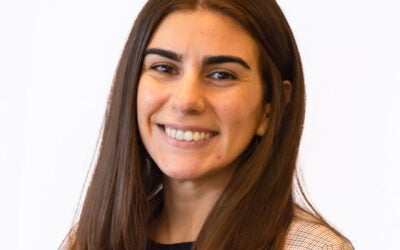
Anna Holdiman, a doctoral candidate in the epidemiology department at the School of Public Health at the University of Texas Health Science Center in Houston, has been selected to receive a Frances Fowler Wallace Memorial Award by the Hogg Foundation. The award will support research expenses for her work to understand integrated healthcare models for people experiencing homelessness. Anna’s work will make an important contribution to the research literature on integrated healthcare for people experiencing homelessness as well as the providers who serve them.
Frances Fowler Wallace, the award’s namesake, was married to John Forsythe Wallace, a member of the Texas House of Representatives and the State Board of Control during the 1920s and 30s. Ms. Wallace died in Austin on July 18, 1972, at the age of 80. As directed in her will, the memorial award provides partial support for doctoral students’ dissertation research on “the cause, treatment, cure, and prevention of mental disease, mental illness, and mental disorders.” The award provides up to $3,000 for research-related expenses.
We spoke with Anna about her research:

Tell us about yourself. At what point did you decide to pursue this line of research, and what influenced that decision?
My background is in clinical speech language pathology, where I worked at several acute care hospitals. In this experience, I was stuck by how people experiencing homelessness, incarceration, and substance use conditions presented as problems to manage instead of people deserving of care, dignity, and evidence-based care. This experience shaped the kinds of questions I want to ask and the type of work I want to do.
Your dissertation is titled: Integrated Primary Care for People Experiencing Homelessness: Service Models, Utilization Outcomes, and Workforce Stigma. What questions are you trying to answer with this work?
My dissertation focuses on understanding integrated healthcare models for people experiencing homelessness that bring together services like primary care, mental health care, and substance use care into one coordinated approach. I am interested in how these programs function, the outcomes they produce for patients and healthcare systems, and how delivering this kind of care shapes the occupational well-being of the workforce.
What excites me most is that this work allows me to support and amplify the incredible work of Austin’s Mobile Medical and Mental Health (M3) Team. The M3 Team is a collaboration between Integral Care, CommunityCare, and Dell Medical School that provides multidisciplinary care to people experiencing chronic homelessness, including those living with mental health and substance use conditions. I feel very lucky to get to work and learn from a team doing such impactful work. I am grateful my dissertation gives me the opportunity to share more about the care model they have built.
What gaps in the literature will be filled by your study? Who stands to benefit from it?
This study fills a few important gaps. First, it brings together the existing evidence on integrated care for people experiencing homelessness in a way that has not yet been done comprehensively. Second, it uses a unique analytic approach to better understand whether these programs improve emergency department utilization over time. Third, it explores the experiences of providers delivering this care, especially the occupational stigma they may face, which is an emerging area of work. Ultimately, this work can benefit people experiencing homelessness, the providers serving them, and the decision-makers who shape whether these programs are sustained and expanded.
How do you think your research methods and approach will help you to answer the questions that you’re posing?
My dissertation uses three methods, each aimed to address a distinct question. The systematic review helps me synthesize what is already known about integrated care models for people experiencing homelessness. The recurrent event survival analysis allows me to examine outcomes over time. The qualitative interviews add depth by centering on the experiences of outreach workers who provide this care. Together, these methods help me understand both the impact of these models and the realities of delivering them in practice.
Are there any suggested readings you can recommend for those who might be interested in learning more about the topic?
For readers who want to learn more, I would recommend the Austin American-Statesman article on the M3 Team’s work here in Austin, which highlights an important local example of integrated care in practice. I would also recommend books like Poverty, by America and Evicted by Matthew Desmond. Both books really helped me better understand the broader systems that shape poverty and housing instability.
Related Content

2026 Frances Fowler Wallace Memorial Award: Morgan Phillips
Morgan Phillips, a doctoral candidate in the Department of Clinical Psychology at the University of Houston, has been selected to receive a Frances Fowler Wallace Memorial Award.

2025 Francis Fowler Wallace Memorial Award: Miguel (Mickey) Garcia
Miguel (Mickey) Garcia, a doctoral candidate in the general psychology program with a concentration in health psychology at the University of Texas at El Paso has been selected to receive the 2025 Frances Fowler Wallace Memorial Award by the Hogg Foundation.
2024 Frances Fowler Wallace Memorial Award: Rebecca Jewell
Rebecca Jewell, a doctoral candidate in the clinical psychology program at the University of Houston, has been selected to receive the 2024 Frances Fowler Wallace Memorial for Mental Health award by the Hogg Foundation.